Building moisture control
Structural Drying in Ellenton, FL
Air conditions, material values and cavity access define equipment needs for each affected section of a home or business. Equipment positions change as framing, drywall and subfloors release retained moisture.
(888) 621-2041Request Structural Drying help- Air and material readings
- Separate drying zones
- Measured ending conditions
Measured factorsAir, materials and cavity access
Airflow purposeRelease moisture from wet surfaces
Dehumidifier purposeCollect vapor from the room
Completion basisStable values at marked points
Structural drying begins with a measurement plan rather than a machine count. Ellenton homes and businesses around Palmetto, Memphis and U.S. Route 301 differ in room volume, finish layers and access to cavities. Technicians identify every retained wet material, select dry reference points and note the air volume serving each zone. Those baselines determine where equipment belongs and what later progress should look like.
How structural drying is handled in Ellenton
- 1
Record air and material baselines
Temperature, humidity and substrate values define the starting condition for every controlled zone.
- 2
Assign equipment by moisture load
Air movement and dehumidification are selected for wet material area, air volume and access.
- 3
Change the plan from trends
Stalled values lead to different placement or controlled access rather than an assumed extension.
- 4
Release completed zones separately
Each retained assembly receives an ending comparison before equipment serving that section leaves.
What does structural drying cost in Ellenton, FL?
Structural drying often ranges from $1,000 to $7,200 or more. Wet material area, saturation, room volume, access and monitoring needs affect the total. Cavities and dense materials may need longer monitoring and adjusted equipment positions.
Single controlled zone
$1,000 to $3,050
- Air condition baseline
- Material reading points
- Focused equipment arrangement
Several affected assemblies
$3,050 to $5,100
- Multiple monitored surfaces
- Cavity access choices
- Recorded layout changes
Complex moisture load
$5,100 to $7,200+
- Several drying sections
- Extended value tracking
- Detailed ending report
For a closer planning number, try the water damage cost calculator. A firm figure comes after the walkthrough and moisture map.
Standing water and unsuitable material come first
Extraction reduces the liquid load before air movers are expected to support evaporation. Contaminated or physically failed porous components are handled under the appropriate removal plan. Temperature and relative humidity describe room conditions, while meters show water retained inside floors, walls and framing. Both sets of information are recorded because dry room air cannot prove that an enclosed assembly is ready.
- Confirm that the source no longer adds water.
- Remove pooling before relying on evaporation equipment.
- Mark each material reading point for repeat measurements.
- Establish dry references inside the same property.
- Keep drying zones arranged as the plan specifies.
Equipment roles stay distinct throughout the process
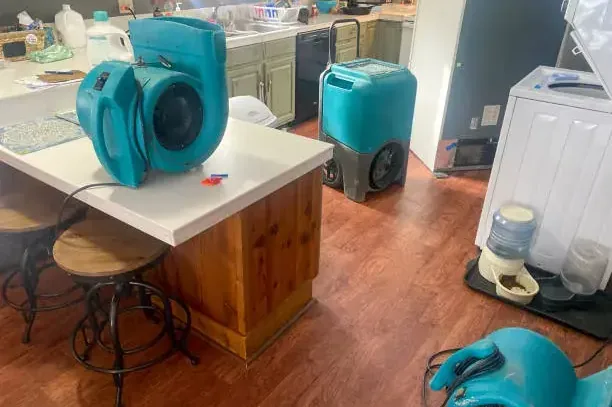
Air movers encourage moisture to leave exposed surfaces. Dehumidifiers remove the resulting vapor so the room can continue accepting more. Placement considers material area, air volume, doors and cavity access. If readings flatten, technicians alter direction, quantity or access instead of merely waiting longer. Enclosed floors and partitions receive their own checks because room humidity cannot describe them completely.
Measurements at consistent locations create a trend. Some materials improve quickly before slowing, while others need an opening before they respond. The reason for each adjustment is written into the monitoring record. The drying time estimator illustrates how saturation and access affect a schedule without setting an unmeasured promise.
Repeated readings show where drying is progressing
Only repeated air and material readings show whether the selected arrangement is working across the whole zone.
Each zone earns its own completion decision
Equipment leaves a section after retained materials compare suitably with established references and the source remains corrected. The closing file lists starting values, placements, changes and ending conditions so repair work does not conceal unfinished moisture control.
Drying is an active measurement process rather than a fixed equipment rental. At an Ellenton property near Palmetto, Memphis or U.S. Route 301, technicians mark comparable points across the affected assembly. They compare those values with indoor humidity, move air where surfaces need it and reduce equipment only when the documented response supports that change.
Coverage
Structural Drying across Ellenton, FL
The team responds across Ellenton, including properties near U.S. Route 301, the Manatee River and the Interstate 75 boundary. The adjoining communities of Palmetto and Memphis also have service information below.
See every area servedQuestions
Structural Drying questions in Ellenton
What does structural drying include?
It is the measured removal of retained water from building materials after the source, standing water and unsuitable components are addressed. Airflow, dehumidification, access and repeated readings work together inside defined zones.
Why measure both the room air and building materials?
Temperature and humidity describe the air, while meters show conditions in floors, walls and framing. Either view alone can miss part of the problem. Together they reveal whether evaporation and vapor removal stay balanced.
How is the amount of drying equipment chosen?
The team considers wet material area, saturation, room volume, water already removed and cavity access. Equipment is assigned to a zone, then adjusted from measured results instead of remaining at a standard count.
Can an enclosed wall dry without removal?
Some cavities respond when the water is suitable, materials remain stable and safe air access is available. Wet insulation or a stalled component may require a controlled opening. Repeated readings support that decision.
Why can one area finish before another?
Materials and access differ across a property. An exposed wall may release moisture faster than a layered floor or insulated cavity. Monitoring allows completed zones to close while slower assemblies continue under a revised plan.
When is structural drying complete?
Retained materials must reach stable values compared with appropriate dry references, and room conditions must support that result. The source remains corrected, with an ending reading for every documented affected assembly. Temperature and humidity readings describe the air, while a material meter tracks the building itself. Both matter. A successful chamber removes vapor without overlooking a wet sill, wall base or subfloor, and the closing record shows how those specific materials changed during the process.
24/7 emergency dispatch
Structural Drying for Ellenton, available 24/7
Stable trends at consistent points determine when each retained material can leave active drying and enter repair planning. Measured progress defines the endpoint for every drying zone.
(888) 621-2041Start Structural Drying care
Ellenton, FL · Find us on Google